Friday, October 7, 2022

Celebrating Fifty Years of Living Here

This month, October 2022, marks the fiftieth anniversary of our moving to this place, our home, a little bit of Heaven on Earth here in Northern Colorado. 

In 1972 there was an old farm house on the property along with a barn, silo, granery, and chicken house. We decided to remodel the house and while doing so needed a place to live so we bought a mobile home and placed it a few yards east of the house.


At that time Bob and I were both working for Union Manufacturing and Supply Co. located at the old Sugar Factory in Fort Collins. Working around lumber and home building each day, we loved the idea of not only remodeling the farm house but adding on to it, transforming the house to fit our dreams. With input from a couple of friends and Lloyd Kahn's two Domebooks, Bob drew up plans for a geodesic dome attached to the farm house. Domes were touted as the least expensive design per cubic foot of space and easy to build. And they were groovy!


Before he could start building the dome he had to put a foundation under the house. That was quite a project. The house was built about 1900 and there was a crude foundation supporting it, one of concrete with large rocks in it but without footings. The people who lived there dug out a cellar and over the years the dirt walls eroded and caused failure of the foundation.


Using stacks of used railroad ties as cripples and long beams provided by Bob's dad, Bob supported the house while Lee Tucker and his son dug out the dirt and piled it high to the north of the house. Some of that dirt was used to backfill around the foundation and the rest became a landmark, a dirt bike trail when our son Patrick was young, and years later a place to build a fort with those same railroad ties for Patrick's son Cortland.

Bob designed a full basement beneath the house and the dome. Working on a tight budget, and doing most of the work on weekends he bartered with local brickmason and friend Lloyd Vlcek to build the basement walls of concrete blocks in a circular pattern to support the dome.  In trade Bob drew the house plans for Lloyd's own home. 


Now the dome construction began. I could go on and on about the process of building and who participated and what happened when. Suffice to say that it took a long time! I like to tell people that building our home became our lifestyle. Sometimes we ran short of money and sometimes our enthusiasm lagged. And the winters were cold and snowy back in the early 70s!


As the photos show, there were very few trees on our property when we bought the place, and no grass. Slowly but steadily we worked on that situation. And most years we planted a garden. 


We were young, healthy, and working full time in town while building the house on the weekends and evenings. We were living our lives, raising our son, and enjoying life out in the country. We have had so many cats that we've lost track of their names. And horses and dogs and chickens and peacocks and more.


The best part of living in our home has been sharing it with family and friends, filling it with music and laughter. We like to think it's a peaceful place with good vibes. And suddenly, fifty years have come and gone, leaving memories of the people who've visited us, eaten at our table, slept in our beds (and some on the couch). And this old house has witnessed it all. Now the floors talk back with creaks and groans when you walk on those fir boards that once supported school kids and desks in LaPorte. Doyle salvaged that flooring when the school house was torn down. And the unfinished pine boards on the walls have absorbed the scents of bacon frying and pot roasts and tacos so when I walk in the door after being outside it smells like home. 

Our son was only four years old that Halloween Day in 1972 when we moved into the trailer house. I remember that because Patrick was concerned he might miss trick-or-treating with the West boys since we no longer lived near them. And now he is fifty-four with three children of his own - I say children but the youngest is seventeen. I am so pleased that all of them, and Patrick's wife, Alejandra for the last twenty years, have "grown up" in our domehome.

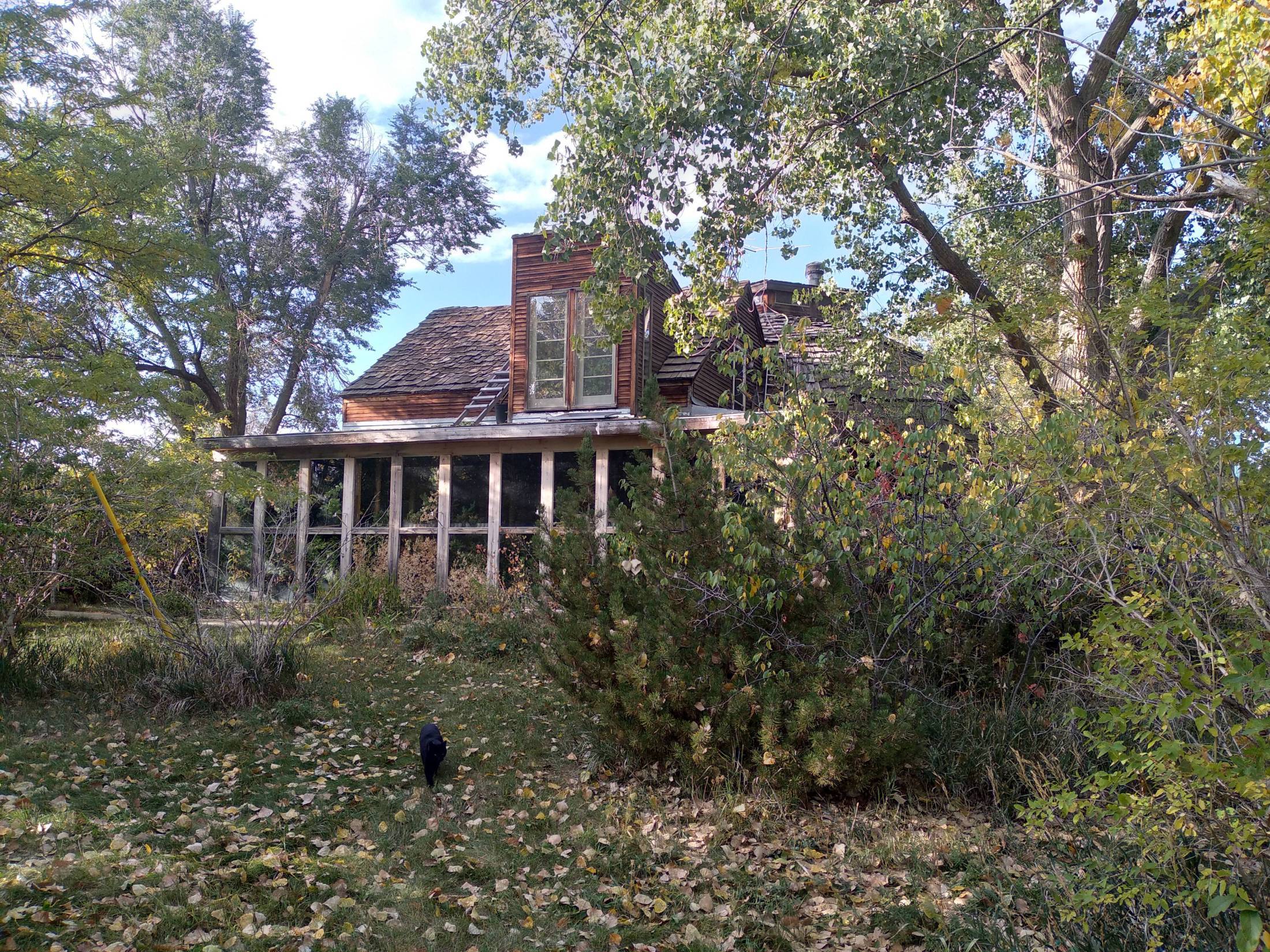
The exterior of our place has changed a great deal with the growth of the plains cottonwoods and the addition of Colorado blue spruce. And over the years Bob has added the greenhouse along the south-facing front of the original farm house. He also replaced the small deck on the east side with a larger, more useful deck and added balusters and railing.


And as for us, after fifty years we are still relatively healthy, happy to be still living in our handmade home, enjoying the wildlife and the trees. But like the old barn out back we tilt a little, need some propping up from one another, and have changed in our looks a bit. In fact, that old barn is a visual metaphor for how we've weathered the winds of change. (Photo by Dan Klein)

Saturday, September 24, 2022

Glorywagon - Part II

I recently wrote the story of "The Glorywagon", the 1920's ranch cook shack turned bachelor's home that has been in the Russell family since 1962, and commented on the task of bringing it to our place in 2000, but did not give proper acknowledgement and thanks to Bill Hilgenberg and his son Steven for their role in loading and hauling it the ten miles or so from Doyle Russell's place to ours. 


The main axle beneath the body of the wagon is broken and has been for many years. I asked Bob Russell how he and his dad were able to tow it behind their farm truck the thirteen miles from Nunn to Doyle's place north of Wellington in 1962 with the axle broken and he said "we cobbled something up." But when it came time to bring it south about ten miles to our place on Highway 1 in 2000 he asked Bill Hilgenberg to load it on one of his trailers and deliver it to us.


Bill has had lots of experience loading heavy equipment on trailers. He owned his own backhoe business for fifty years or so in Larimer County and knows how to load, tie down, and unload as efficiently as can be done. Watching Bill and Steven load the Glorywagon was fascinating. 


The trailer was just barely wide enough, or maybe I should say the wagon was almost too wide and too long to fit on the trailer. In the photo one wheel is hanging over the edge a few inches.


And the weight of the wagon required some careful tugging and shoving by Bill's heavy equipment to get it up on the trailer. I remember watching Steven assist his dad in this operation, throwing chains, cinching them down, laying beneath the wagon as he worked, and I appreciated his skill with his hands and willingness to get dirty, do the hard stuff. His dad taught him well.


Bill and Bob inspected the loaded wagon and found it road ready.


Twenty minutes later the guys arrived with the Glorywagon, backed the trailer into place, and started the process of removing the chains and offloading the wagon. Frankly, I don't remember how they did that! They rolled it off and positioned it exactly where Bob wanted it placed.


Job well done! Thank you Hilgenberg and Sons for bringing the Glorywagon to us. Delivering it to us is not the only project Bill Hilgenberg has done for us over the years. He's hauled gravel for our driveway, moved broken concrete slabs into a heap and covered them with soil, breaking off large cottonwood branches with his backhoe, all in an effort to create a place to sit and watch Bob train his horses out back. Bill has dug water lines, installed hydrants, and more. The most exciting project was when he tore down our silo! I took photos that day and movie film and when the silo finally collapsed my movie captured a few of the blocks as they flew through the air headed right for me and the camera! And the most recent project, one I requested of Bill, was the creation of a seating area beneath some trees using stone slabs that came from Doyle's place. Only, by then, it was Bill's place, for Bill Hilgenberg bought Doyle's property from the Russell family after Doyle died in 2000. Thank you, Bill, for all you've done for us over the years. Bob and I appreciated it greatly.


And there she is, all ready for renovation. I thought it would be so simple. After all, it's only 8'x18'. Ha! It took many years and untold man hours to restore this small wooden wagon on wheels.


Tuesday, September 20, 2022

Glorywagon

In our yard sits an old cook shack on wheels, a hundred-year-old mobile cabin of sorts. We've had it for over twenty years now, and Bob, with help from his friends, has restored it and saved it from falling apart. His mother, who saw the thing as a dirty, dilapidated wagon, sarcastically dubbed it "The Glory Wagon". The name stuck.

Before I show the process of restoration I want to tell the history of this interesting little building. In the 1920s it was a cook shack that was hauled out into hay fields of eastern Colorado at harvest time each fall by a steam tractor, for it was too heavy to be pulled by horses. Local farm wives who did most of the cooking and meal preparation at home brought the warm food to this cook shack for distribution to the haying crew at mealtime. There was a small woodburning stove inside for keeping the food warm and making hot coffee.

This photo of a typical cook shack of that time is from a cook shack museum in Kansas. Our wagon has big iron wheels that were once part of a stationary steam engine, used with a threshing machine. It's hard to know how old the wheels and undercarriage are. We think the wagon was built about 1910. When the U.S entered WWII in 1941, and the harvest crew men went off to war, this cook shack was retired from use. A 78-yr-old old bachelor named Albert Bisworm moved into it and made it his home in Nunn, Colorado for the next ten years.


Ten year-old Bobby Russell poked his head into the doorway of the wagon in January 1953. He remembers that date because while in Nunn that day he and his family heard the sad news that Hank Williams had died. Bisworm had just moved out and gone to Greeley to a nursing home. Bob says the inside of the wagon was so dark with soot that there was no way to know how big it was inside. No light came in from the four windows. A 2-burner kerosene stove toward the back had sooted up the place terribly. Alec Keenan, an 80-year-old resident of Nunn, hauled the wagon to his property and there it sat another ten years. This photo shows how these retired wagons became small homes.

Doyle Russell, Bob's dad, acquired the Glorywagon in the early 1960s from Alec Keenan and towed it behind his farm truck the thirteen miles to his place north of Wellington. I don't know what Doyle's plans were for it at that time but he filled it up with purchases from the local auctions and the first time I peeked inside, about 1980, there were many old vacuum cleaners stored there. At some point sparks from a passing Burlington Northern train set the dry prairie grass on fire and it burned the "backporch" of the wagon.


Bob told his dad he would surely like to bring the Glorywagon down to our place and clean it up. Doyle agreed to that plan but said he wanted to empty it out first. Years passed. After Doyle died in 2000 a friend of Bob's loaded the wagon onto his flatbed trailer and brought it to our place, placing it just where we wanted it, west of our house, in the area where we park our cars. Inside we found two items that dated back to Bisworm's occupancy, a pair of longjohns stuffed in a crack, used to keep out the cold wind, and a wire run up to the roof that served as a radio antenna. 

Bob started restoration with the removal of the newspapers that covered the interior walls. Although soot had damaged the first layer, the inner layers were readable and interesting, complete with the "funny papers." He mailed them to his brother, Ken, who shared his love of cartoon strips. Then Bob removed all the roofing and discarded it saving only the crossbeams.


Using 1x6 pine boards he bent them over those crossbeams and nailed them in place creating a clean, strong ceiling and roof. 

After the pine boards were in place Bob and Bill West covered them with dark green rolled roofing.


Pam, taking photos from inside as Bob creates the new roof.


This shows the completed ceiling, taken at an angle. That's the door at the far end.

On the exterior he secured all the vertical siding with screws. Bill West made new windows using old mullions to look compatible with the siding. Bill also surprised us with a custom stained glass window for the front of the wagon, with an "R" for Russell in the design.


This window is actually in the front of the wagon, the front being where the tow bar connected to the steam tractor which hauled it out to the hay fields. The back of the wagon is where the door leads out to the porch on which the meals were served.


On the inside Bob covered the old walls with new 1x6 pine boards to give a fresh, clean surface that the Glorywagon hadn't seen in decades.


That "back porch" that was burned had to be removed and rebuilt. Back in the days when it was a cook shack this is where the food was set out on platters so that the haying crew could walk by and fill up their plates, then find a place to sit and eat their suppers. Rebuilding it was one of the most challenging tasks Bob faced during the restoration. He wanted it to be as close to the original construction as possible complete with the wide, flat surfaces on top. It turned out really well!


To finish up the exterior Bill West made a beautiful door complete with hardware and they hung it together. Later a screen door was installed inside so the solid door could be open to allow air flow. And a set of stairs with handrails completed the project of making the Glorywagon accessible and secure. I love the look of it. Great job!


As for the inside, as soon as the roof was on I started making the inside "liveable". The front of the wagon has a raised flat area with two storage compartments below. I put custom mattresses over that, a pretty quilt, and lots of pillows. We added a small table with a couple of chairs and then decorated with old collectibles we like looking at.

There is a pedal sewing machine, enamelware, cigar boxes, old dolls, and more.


Mostly the Glorywagon has become a cozy backdrop for photos of visiting family and friends. It has a good feel to it, this little cabin, if you like things rustic, and are nostalgic for years gone by, like I am.


Our friends Cathy and Pete Safiran gifted us with one of their custom license plate signs "StageStop58" to link the Glorywagon to my ebay presence. 

In today's world with the advent of Tiny Houses to solve the problem of affordable housing this tiny 144 square foot structure (8'x18') has been there, done that. Albert Bisworm had a small stove, chamber pot, and a radio - all the comforts of home. I know if Frances Russell could see the old Glorywagon today, how her son Bobby gave it new life, she would exclaim, "Oh, my Gawd!"

Tuesday, August 23, 2022

Gauchos

When Bob Russell was a young boy in the 1940s growing up on a dryland farm in eastern Colorado, middle child in a family of six (four kids), the Sunday issue of the Denver Post newspaper was one of the family’s highly anticipated reading delights. His mother, Frances, read the “funny papers” out loud, each and every comic in the paper. She loved reading aloud, acting out the parts, speaking with various appropriate dialects, a highly entertaining woman, was Frances. At that time the family followed the happenings of “Li’l Abner”, “Gordo”, “Mutt and Jeff”, “Gasoline Alley”, “Prince Valiant” and others. Bob still reads Prince Valiant every Sunday without fail, one of the few cartoons that has lasted these eighty years. This happy, fun, family event each Sunday morning instilled in Bob a life-long love of the funny papers. Cartoons became a favorite art form, a passion.


The Pierce Grain Elevator in Weld County gave away calendars each year to its local customers and in the mid 1940s those calendars featured the art of Argentinian artist Florencio Molina Campos and his gauchos. Gauchos are the South American version of our cowboys. Bob Russell came to love the lively action of those gauchos with their “funny looking horses”. He spent hours studying the paintings, drawing the characters on paper, always wondering what the Spanish captions meant, just a few words beneath each painting.


Fast forward to the year 2000 when our son, Patrick, introduced us to his fiancé, Alejandra, from Buenos Aires, Argentina. Although her English language skills were limited at that time and our Spanish language skills non-existent, Bob felt an immediate kinship with Alejandra because of his interest in the gauchos on the Argentine pampas. With Patrick translating each conversation, Bob explained to Ale his fascination with the gaucho culture which included their knives, horses, clothing, and love of beef! He even had some Campos prints purchased from the internet just a year before we met her.


Alejandra with her Uncle Carlos who was closely connected to the gaucho culture. On one of her visits back to Buenos Aires she brought back a photo of her Tio Carlos wearing his traditional clothing with Ale posed beside him.


And she and Patrick brought Bob two wonderful books with full color photographs of paintings, “Martin Fierro” by Jose Hernandez and “Gauchos Argentinos” by Aldo Sessa, along with Argentine made knives, bolo, and leather goods. I know if they had brought him bombachas he would be wearing those!


Patrick and Alejandra tried to translate the captions or titles of the Campos paintings but it was not easy. The artist used idioms specific to the gaucho life on the pampas so translating them to some English form we could understand proved about as successful as translating 1880 cowboy terms like “get along little dogies” to a tourist from Japan.


We were surprised to learn from Alejandra that not everyone in Argentina liked Molina Compos’s paintings. Some were offended by his caricatures, thought he was making fun of the people in his paintings, that he made them look ugly, not beautiful. One amazing thing I learned about him is that he painted all those scenes from memory, years after living out on the pampas, later in a studio he painted what he saw in his mind’s eye.


When Patrick and Alejandra’s son, Lucas, was born we were privileged to spend a lot of time with him, watched his personality emerge, and saw a couple of traits that made us smile for they were so gaucho-like. We had horses then, and one day two-year-old Lucas walked out to the pasture with his grandpa, climbed up on the bottom rung of the fence and started shouting at the horses, pumping his little right fist at them as he exerted his command. That was not something he learned from Grandpa.That was pure Lucas. And he loves knives, has always loved knives. Not bicycles, not airplanes, not Hot Wheels, but knives, always knives. A gaucho's knife is his main tool, one of his only tools, used for everything from eating his meal to chopping firewood, to butchering beeves. (Note: this photo of Lucas and his grandpa out feeding the horses was taken when Lu was a bit older. I didn't capture that moment when he was only 2.)


We’ve come full circle with this fascination for Argentine gaucho culture, a beautiful thing. This fall Patrick and Alejandra hosted their annual Asado, a traditional Argentine BBQ, at our place, out back, beneath the old cottonwood trees. After an afternoon of cooking and dining on traditional foods, late at night there is music, dancing, laughter, even a few tears. The guitars, and this year a saxophone, set the mood with their lively music tinged with sadness. The fire throws shadows and warm colors across the dancers and musicians, and if I squint my eyes a little I am a part of an authentic South American celebration of life and love. Thank you, Alejandra, for bringing this beauty from your country into our lives and hearts.


Friday, June 18, 2021

Fathers' Day 2021


Like so many people these days I had more than one father. There was my biological dad, Joe Uknavage, who was in my life from conception until he passed away, my “real” dad. And always on Fathers’ Day I think of him, write of him, remember him with love.


Then my mother remarried in 1970 after she and Dad divorced and her new husband, Manuel “Talley” Talamantes, became my step-father. I was already married, had a son, and had recently moved from Illinois to Colorado that summer of 1970 so Talley was not a big presence, or a constant presence in my daily life. However, my younger sister was only fifteen years old and her life changed dramatically when Mom remarried for Talley had three children with his ex-wife and their kids lived with him and Mom most of the time.


Mom and Talley only had seven years together before she died unexpectedly at the age of forty-nine in April of 1977. Talley, six years younger, died in 1998. My purpose in writing this is not to tell the story of their marriage but to say that I have never fully appreciated this man in my life, my step-dad, who suddenly became a parent to three adult children and a teenager (me and my siblings), and handled that responsibility quite well, in my opinion. 


It was not easy integrating families but Mom and Talley did that successfully. And he loved my mother, treated her with kindness and respect, for which I am eternally grateful. Their life together had its challenges but for seven years they both worked fulltime, raised Talley’s three children and my younger sister, and looked forward to their vacation each summer when they towed their camper all across the west and southwest, stopping here in Colorado to visit us, then meandering down in to Texas where Talley’s father still lived, visiting tourist sites along the way.


Happy Fathers' Day, Joe Uknavage
and Talley Talamantes. I appreciate you both more and more as I grow older, and only wish I had told you both I loved you, thanked you for being my dad.